Gary Markstein:

big on love, tolerance, and the human potential
Gary Markstein:
Politicians arguing tax policy is toothless gumming and that’s that.
Fiddling with taxes is a lazy substitute for a lack of direction. Taxes are a slow, unwieldy policy tool likely wrong or impotent before any desired effect will be realized across the economy. And for that matter, fiddling with budgets is slow and lazy policy too.
Since the 1950s, taxes are a difference that make very little difference.
There have been more than 30 major changes in the tax code including personal income tax rates, corporate tax rates, capital gains taxes, dividend taxes, investment tax credits, depreciation schedules, Social Security taxes, and the number of tax brackets among others.
Yet during this period, federal government tax collections as a share of GDP have moved within a narrow band of just under 19% of GDP.
Raise taxes. Lower taxes. It’s almost irrelevant. It’s a noisy cover.
Arguing about taxes seems to be a true and reliable indicator there’s significant confusion about operating a workable economy. The chart below might reveal that taxes become an issue whenever the economy falters. Political and pundit fingers point, arms flail, only to reveal their errors continue.
Anyone Else Believes Taxes Pay Bills Or Generate Faster Economic Growth? [link]
Tax up. Tax down.
1. You can tap dance.
2. You can tap dance.
We could fund the government if we knew how to bill for bullshit. What’s missing is invigorated economic action, city-by-city, sector-by-sector, with far less bleeding from useless finance packaging, from dangerous and sloppy waste embedded in so many forms, and by reversing leadership capture and relentless fraud.
It’s nuts to exploit ineffectual issues when we must revitalize and renew.
The years of tax hikes [in red] collect 19.3% of the GDP.
The years of tax cuts [in gray] collect 18.2% of GDP.
You can calculate this difference is ample. Regardless, taxes is not the topic that matters these days.
Tax rates. It’s our shame we have too little better on the agenda.

Our ignorance is not so vast as our failure to use what we know.
—M King Hubbert
Jim Quinn’s ‘Lies Across America’:
If Americans were capable or willing to do some critical thinking, they would realize that those in power have created the illusion of a recovery by:
• handing $700 billion of your money to the banks that created the financial meltdown,
• spending $800 billion on worthless pork barrel projects borrowed from future generations,
• dropping interest rates to 0% so that the mega-Wall Street banks can earn billions risk free while your grandmother who depended on interest income from her CDs edges closer to eating cat food to get by, and lastly,
• blatant attempt to enrich Wall Street in an effort to make the stock market go up, while the middle and lower classes are crushed under the weight of soaring fuel and food price increases that exceed 30% on an annual basis.
The illusion of recovery is not a recovery.
With a true unemployment rate of 22%, a true inflation rate of 8% and a real GDP of -1.5%, we are in the midst of the Greater Depression.
You are being lied to, but most of you prefer it.
Think on this. On both sides of illicit drugs is massive buying power.
1) On one side, Americans pay large sums of money to vast networks of people who grow, process, ship, smuggle, defend, and deliver drugs to the US.
2) On the other side, Americans also pay another network of people vast amounts to find, fight, arrest, and kill those whom we hire to provide the drugs to begin with.
“US dollars finance both sides of this bloody international battle.”
The four-decade ‘war’ on drugs has failed. Next?
North Korean Navy preparing for war. 🙂
Some say without China, they cannot dare.

Normal human ageing could be slowed by protecting chromosome tips.
“This may be one of several things you need to do in order to extend lifespan and extend healthy living.”
 Ample telemorase doesn’t just prevent ageing. It can reverse it.
Chromosomes have caps called telomeres at their ends. As cells divide, telomeres shorten, eventually cells stop dividing and die.
Telomerase prevents this decline in some kinds of cells.
A spray solution of a patient’s own stem cells is healing their severe burns.
 University of Utah pilot project showing remarkable results.
“We can only imagine a day when sheets of pristine skin might be available to any patient off the shelf.” —Dr. Amalia Cochran, U of Utah Burn Care Center.
Matt Taibbi’s Griftopia …the tail end of all this frantic lying, cheating, and scamming:
We paid for this instead of a generation of health insurance, or an alternative energy grid, or a brand-new system of roads and highways.
With the $13-plus trillion we are estimated to spend on the bailouts, we could have not only bought and paid off every single sub-prime mortgage in the country (that would have only cost $1.4 trillion), we could have paid off every remaining mortgage of any kind in this country — and still had enough money left over to buy a new house for every American who does not already have one.
Shadow banking is double the size of all conventional banking.
On the 18th of November, Gillian Tett, award-winning journalist at the Financial Times published a road map to the $20 Trillion shadow banking system. [NY Fed source pdf here]
Examples of shadow banks are finance companies, commercial paper companies, structured investment vehicles, credit hedge funds, money market mutual funds, securities lenders, and government-sponsored enterprises.
This week, a senior banker friend gave me a poster entitled The Shadow Banking System. It was shocking stuff.
The graphic depicts how money goes round the modern world. Most of the poster is dominated by shadow banking systems. These flows are so extraordinarily complex that hundreds of boxes create a diagram comparable to the circuit board.
It should be mandatory reading for bankers, regulators, politicians and investors today, a reminder of clueless investors, regulators and rating agencies.
“After all, during the credit boom, there was plenty of research being conducted into the financial world; but I never saw anything remotely comparable to this road map.”

Candidates and political committees spent ~$3 billion on midterm advertising primarily controlled by 15 Washington operatives paid fees of $400 million. Well how do you like that? Corporate henchmen with the GOP establishment creating and directing a Tea Party uprising. Yes.
Every country has scam artists, but only in a dying country are they part of the power structure. —Matt Taibbi
Adam Smith proposed cognitive capitalism and we’re far from that.
If people really knew the so-called financial constraints were no such thing and the fiscal austerity programs are thus political choices and alternative political choices not involving harsh austerity are available – then I think the public debate would be different and ultimately different outcomes would emerge. —Bill Mitchell
How do we tap the economic wealth within our nation?
We have put ourselves into a deep hole, not merely because of government, but by runaway rent seeking, convenient extraction, unproductive scavenging, distorted speculation, crony opportunism, and incumbent plundering. Austerity is digging us deeper and will never get us out.
It’s clear we’ve failed to invent an efficient workable economy. Instead of robust planning and cooperative vision, and government funding it, we’re achieving far too little.
We’re accepting spurious counsel. What we get since Milton Friedman and the Laffer Curve, so to speak, is bubbles and dips. And the tricks of Republicans and Blue Dogs posing as tax cutters but merely tax shifting in a scheme of greed.
We endure an incapable policy against global challenges of fuel, population and trade. Slim growth over several decades was not widely shared. The economy did not trickle down as promised.
It’s a mistake to think that because the economy starts growing again, all will be well. If the growth that occurs post-recession simply picks up where pre-recession growth left off, flowing mainly to the upper classes and with even more income inequality than we have now, the frustrations and tensions will continue to build and our troubles will not have ended.
There’s so very much wrong in our political thinking and economic understanding. In many ways. Over a long period. We’re vehement and enraged, yet we’re electing noise to represent our views and ignoring what’s abusing our worth.
Bruce Bartlett says the starve the beast theory is a crackpot theory, a favorite Republican rationalization “for Republican budgetary irresponsibility”.
There is, for instance, no historical data that would demonstrate that a balanced budget enhances gross domestic product (GDP) or any other indicator of economic productivity. —Michael Johns
By favoring Wall Street’s finance packaging, hoisting it over America’s economy while a cash hoarding corporate elite fails to innovate and reply, we’ve abandoned the economic growth we truly need.
 “For years, the most profitable industry in America has been one that doesn’t design, build, or sell a single tangible thing.” —John Cassidy
A fix, they say, is to freeze government machinery, to slash budgets and offload costs, to shrink and eliminate. ‘We must balance the budget’, they say. ‘The government has too much money. And it’s not using it well. We need to stop government. Starve government. Cut taxes. Cut programs. Stop earmarks. Strip government.’
That’s the deficit myth, says Rodger Mitchell. “No evidence exists that deficits have any negative effect on our economy.”
We’re ignoring a crucial point: Government does not use our money. It creates it.
A public sector DEFICIT is equal to the private sector’s SURPLUS. To the penny. —Stephanie Kelton
“Spending is absolutely, positively necessary for economic growth.” And the Federal Government has the exclusively unlimited power to create the funds we require.
“It creates money by its spending.”
The money supply must grow enough to overcome inflation, population growth, a negative balance of payments and the needs of a growing economy.
The real problem today is lack of money.
Austerity will badly cripple us.
Federal spending creates money.
Federal taxing destroys money.
The only so-called ‘debt’ problem is that the debt is too small to recover from the recession.
The debt hawks have been telling the world the sky is falling for many decades, and they consistently have been wrong.
The real problem today is lack of money.
The debt hawks have limited Social Security, limited universal health care insurance, limited infrastructure restoration, limited research & development and limited economic growth.
They have caused more harm to America than the worst traitors and terrorists ever could dream of.
Less government spending will result in less money in our pockets. Why? Because government spending is precisely the same as adding money to the country.
“If our nation can issue a dollar bond it can issue a dollar bill.” —Thomas Edison.
When we stop government, we stop money at its source.
Federal spending creates money.
When the US government slows deficit spending, the result has been a recession in every case.
The U.S. has had 6 depressions in its history. Every one of those depressions followed a series of federal surpluses. All were cured with deficit spending.
1817-1821: U. S. Federal Debt reduced 29%. Depression began 1819.
1823-1836: U. S. Federal Debt reduced 99%. Depression began 1837.
1852-1857: U. S. Federal Debt reduced 59%. Depression began 1857.
1867-1873: U. S. Federal Debt reduced 27%. Depression began 1873.
1880-1893: U. S. Federal Debt reduced 57%. Depression began 1893.
1920-1930: U. S. Federal Debt reduced 36%. Depression began 1929.
The U.S. has had 9 recessions in the past 50 years. Each of those recessions came on the heels of deficit growth declines, and each recession was cured with deficit growth increases.
Despite all the hand-wringing and dire predictions, there is absolutely no evidence deficits cause any negative economic effect, or that large deficits are ‘unsustainable’ or must be paid for by our grandchildren.
There is a mountain of evidence that deficits are necessary for economic growth, and the larger the deficits the faster the growth.
Warren Mosler’s 11 Steps To Fix The Economy:
1. A full ‘payroll tax holiday’ will restore ’spending power’ and, by allowing households to make their mortgage payments, will fix banks from the bottom up.
2. A $500 per capita federal distribution to all the states to sustain employment in essential services, service debt, and reduce the need for state tax hikes.
3. A federally-funded $8/hr job and healthcare benefits for anyone willing and able to work. The economy will improve rapidly.
4. Making banks utilities.
5. The Federal Reserve should lend to all member banks to ensure permanent liquidity. The FDIC already regulates and supervises all bank assets.
6. The Treasury should issue nothing longer than 3 month bills.
7. Don’t tax good banks for losses by bad banks. This serves only to raise interest rates.
8. Directly fund housing agencies to eliminate hedging mortgage rates.
9. Homeowners being foreclosed should have the option to stay in their homes at fair market rents with ownership going to the government at the lower of the mortgage balance or fair market value of the home.
10. Remove ’self imposed constraints’ that serve no public purpose. This is left over from the gold standard days and is currently inapplicable.
11. Federal taxes function to regulate aggregate demand, not to raise revenue per se, and therefore should be increased only to cool down an overheating economy, and not to ‘pay for’ anything.
Linda Beale says, “This emphasis on the deficit seems to be off track. “
It has little or nothing to do with getting the US economy back on a good, sustainable track that will provide a decent standard of living for Americans, with sound support for a strong middle class, the backbone of the country.
Deficits aren’t the ‘evil of all evils’ that these commissions and their backers make them out to be.
The notion that federal debt is ‘unsustainable or will cause inflation’ is simply not borne out by the facts. “Spending is absolutely necessary for economic growth.”
The entire ‘reduce-the-federal-debt movement is suicidal. It’s like prescribing a reduced calorie diet to a starving patient.
Ordinary people are being called to sacrifice even more, when they are bearing already heavy burdens from the financial crisis, high unemployment and high rates of foreclosures.
In the name of deficit reduction, these ‘experts’ want us to forego tort remedies against institutions that cause life-long harms that cannot be made whole. In the name of deficit reduction, they want us to work longer and retire with less benefits, while there is no provision for eliminating the capital gain preference giving those who have income from capital assets an easy pass on taxes.
When people or business aren’t spending, the government must spend.
That money is the fluid that drives the economy.
If it isn’t there, we will have a double dip recession or worse.
Cutting back government expenditures in the drastic ways called for now (10% of federal workers fired, etc.) will have a negative impact on the economy that will ripple through ordinary Americans’ lives.
Balancing the books will not help us because government debt isn’t our major problem.
Clearly today’s political rant is off base.
Government stimulates the economy by adding money. Deficits stimulate the economy by adding money. For that matter, agency budgets and earmarks stimulate the economy by adding money.
We’ll be in a much bigger mess if we slash and burn government spending.
A dearth of leadership, confusion among politicians, insolvent experts, and our own electorate is misdirecting us. We’re listening to calls of restraint in an era of restraint. We’re listening to old century bookkeepers that offer nothing to invigorate a desperate nation already crushed in poor distribution overridden with robbers.
The Cause and Impact of Crony Capitalism: The Great Stagnation and the Great Recession.
The current over-leveraged state of the consumer in the developed world can be papered over by increased government spending but in the face of increased cronyism, it only kicks the can further down the road.
I’ll only listen to proposals that take us to the scale and efficiency that meets our needs with ample prosperity to execute true sustainability and sensible exchange of what we call money.
The federal budget is not a household or company or state or city budget:
Whenever a demagogue wants to whip up hysteria about federal budget deficits, he or she invariably begins with an analogy to a household’s budget: “No household can continually spend more than its income, and neither can the federal government”. On the surface that, might appear sensible; dig deeper and it makes no sense at all. —L. Randall Wray
It’s so nuts these days, Richard Nixon seems sensible:
We need new rules if we are to meet this challenge, but most of all, we need sustained and serious action and cooperation by millions of men and women if we are to achieve our objective, and that means millions of Americans across this land listening to me tonight.
Let me conclude by restating our overall objective. It can be summed up in one word that best characterizes this Nation and its essential nature. That word is “independence.” From its beginning 200 years ago, throughout its history, America has made great sacrifices of blood and also of treasure to achieve and maintain its independence. In the last third of this century, our independence will depend on maintaining and achieving self-sufficiency in energy.
What I have called Project Independence 1980 is a series of plans and goals set to insure that by the end of this decade, Americans will not have to rely on any source of energy beyond our own.
As far as energy is concerned, this means we will hold our fate and our future in our hands alone. As we look to the future, we can do so, confident that the energy crisis will be resolved not only for our time but for all time. We will once again have plentiful supplies of energy which helped to build the greatest industrial nation and one of the highest standards of living in the world.
The capacity for self-sufficiency in energy is a great goal. It is also an essential goal, and we are going to achieve it.
Tonight I ask all of you to join together in moving toward that goal, with the spirit of discipline, self-restraint, and unity which is the cornerstone of our great and good country.
A Data Driven Look at Presidents and Policies Would Be Nice
E Pluribus Unum and Our Finest Hour
 The main role, the driving force, the entity that either provided the original vision and/or drove that vision through to completion was the government.
The government is providing a role that the private sector simply isn’t, cannot, and will not.
The for-profit private sector plays the role of sidekick or supporting actor, [or extracts wherever it can]. The only force that can unite the country, that can create a cause around which everyone will rally around, and then only certain circumstances, is the government.
That is why the American Empire has been petering out. We are less than two months shy of thirty years from the day when Reagan told us the government is the problem, and we have bought into that mantra hook line and sinker. And in the Tea Party era, it is hard to see how that can be turned around. The long, slow decline is becoming inevitable.
We have a dangerously poor group of leaders and thinkers these days offering little more than argument and prowess.
I’ll know we’ve found thinking leaders when plans appear that are not leverage and dominance but instead repair neglect, reduce damage, correct errors, restrain pilfering, improve sectors that are in very much trouble, and most importantly, propose a practical prosperous economy. I’m not hearing that. That’s what we’re missing.
The federal government can fund any future we can invent! When leaders offer a sensible future we’ll create it and we’ll use ample and available federal funding to get there.
Paul Woolley is a seventy-one-year-old Englishman who has set up an institute at the London School of Economics called the Woolley Center for the Study of Capital Market Dysfunctionality.
“Why on earth should finance be the biggest and most highly paid industry when it’s just a utility, like sewage or gas?”
via whimseySpeaks
Our media gives us an aspirin when we could really use a lobotomy.
On the combination of peak oil and extraction damage, here’s snippets and comments from Kunstler’s provocative clusterfrak nation, the “stickiest web of frauds and swindles ever run in human history”.
We’re going to need a cabinet-level Boondoggle Czar.
On finance plunder and our slow-motion train wreck, Ben says:
Everybody is getting the nature of the collapse all wrong.
It’s happening now but it’s slow. There is no tipping point, no cliff. Just slow decent, notch by notch, day after day, forever.
I live in Africa and believe me, folks, you have no idea how much things can deteriorate, how poor you become, how many services can fail while at the same time there are still rich politicians and their business pals driving in big limos down new freeways doing exactly what they want.
Where I live half the population under 30 has no job and no hope of getting one. A third of country live in shacks. There are plagues, no-go zones, corrupt pigs demanding bribes everywhere, more taxes. But at the same time more golf esates, more BMW X6s and more silicone breast implants than ever before!
It becomes normal very quickly, trust me.
If you’re waiting for some kind of poverty limit to spark revolt you’re going to wait forever.
And another take on horizontal drilling and shale fracturing that the natural gas industry says will save us:
It IS amazing.
“How eager the USA is to mount a campaign to sustain the unsustainable at all costs, including massive collective self-deception. The lying starts at the very top.”
Amen!
All anyone seems capable of is kicking the can down the road without regard to the longer term.
Individuals frack expenses for one more month. CEO’s frack their accounts for one more quarter. Politicians frack us all for one more term. The outliers who argue for conservation and sustainability are ignored or told to go frack themselves.
What a system we have. We are so fracked!
Funny. There actually is a town in PA called Frackville.
“I’ve read that in the Depression, Americans were more willing to lose their homes than their cars.”
Makes sense. You can live in your car, but you can’t drive your house.
What about the guy who invented the engine that runs on water?
That we would pollute and destroy the planet in order to continue the non-negotiable American lifestyle sounds like a science fiction fantasy. Except that its true.
The Texan architect of Republican power in Congress was convicted yesterday of two felonies. Contaminant of our lives and damn the technicalities.
We need a better schadenfreude, not mere pleasure after justice, but recognizing we are deer that do not run from wolves.
On the goodness of the Puritans.
Isn’t the deeper issue what the people who came here were like, not what they ate in 1621?
What did they hope to gain by coming to the New World, and what values did they seek to practice?
American theocracy? “The opposite is true,” says David Hall.
Overnight, most of the cruelties vanished.
Puritan rules and values are the basis of our separation of church and state… to restrain the clergy… to restrain the uses of power… to transfer authority to the people.
Ministers were not allowed to hold political office. Out went bishops. Out went centralized governance… The colonists turned away from all forms of hierarchy.
Obama to nation: ‘We’ve got to look out for one another’.

The definition of mental illness is changing.
Consider schizophrenia.
Schizophrenia may ‘capture’ up to 11% of our population. Oops.
And there’s ample evidence that hallucinations, delusions, reality distortions, unusual magical beliefs and psychosis-like experiences are present in everyone.
“So What Is Mental Illness?”
In essence, there is nothing truly ‘mental’ about a mental disorder.
1) It’s a behavior or pattern occurring in an individual, causing clinically significant distress or impairment, reflecting an underlying physical dysfunction, and is not primarily the result of social deviance or conflicts with society.
2) It’s also not just a response to a stressful event like a friend or family member’s death, where it’s normal to expect someone to appear “depressed” or otherwise disturbed for a period of time.
3) A mental disorder is an underlying psychobiological dysfunction—a physical problems in the brain.
Our media shames us while she’s promoted.
 Fox News: “How would you handle a situation like the one that just developed in North Korea?”
Sarah Palin: “But obviously, we’ve got to stand with our North Korean allies. We’re bound to by treaty….”
Fox News: South Korean.
Sarah Palin: “Eh, Yeah. And we’re also bound by prudence to stand with our South Korean allies, yes.”
The New Yorker’s airport security cartoons:

At best, unfolding now in the US economy is a recovery largely tied to exports that’s creating some moderate new job growth, but at much lower wage levels. The United States, like the rest of the OECD, is now succumbing to the global wage deflation that was masked by last decade’s credit bubble.
As a result, and on many measures, poverty is soaring in America and in California especially as increased food and energy costs collide with new, lower payscales. Worst of all however is that the meager public assistance that millions of Americans now collect–the billions in food stamps and unemployment checks–are no match for rising prices of gasoline, bread, milk, coffee, sugar, and meat.
Indeed it is not merely the unpleasant fact of The American Dole in all its breadth, but, that these coupons are set to decline in value.
While congress will no doubt debate these billions and discuss federal obligations in static terms, what’s now set in motion is the loss of purchasing power of government benefits. And that may be the surprise that the political complex doesn’t see coming.
By combining reflationary quantitative easing and a failure to reform the financial system, in an era of higher commodity prices and deflating wages, the United States is not building an economy so much as a poverty machine.
The failing speculation machine since Reagan extracted from the real economy that we failed to improve.
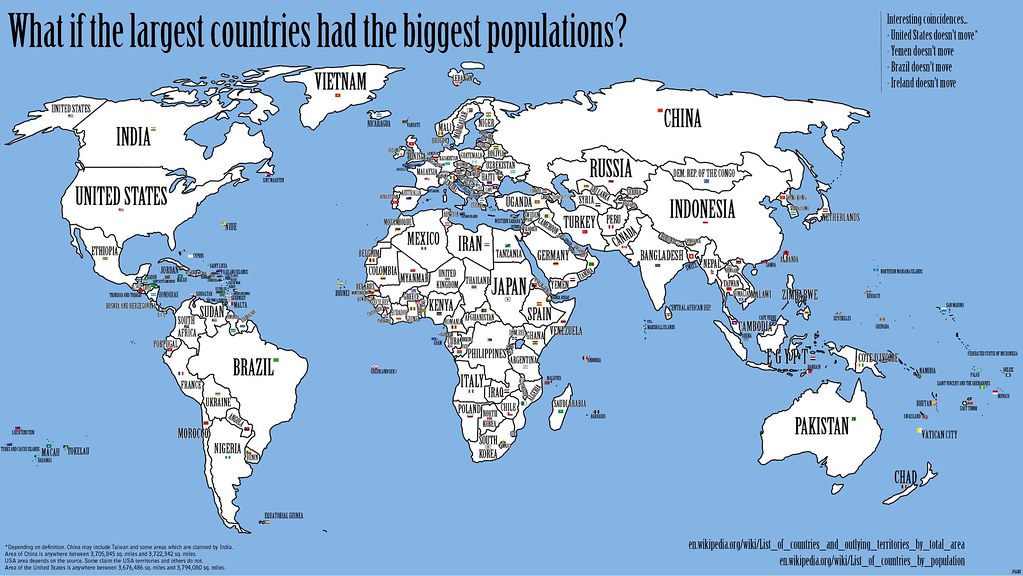
BigThink wonders, “Hmm. If we adjusted nations according to their population….”
[click pic for larger]
Sen. Bernie Sanders, Independent U.S. Senator from Vermont
In 2007, the top 1 percent of all income earners in the United States made 23.5 percent of all income — more than the bottom 50 percent. Not enough!
The percentage of income going to the top 1 percent nearly tripled since the mid-1970s. Not enough!
Eighty percent of all new income earned from 1980 to 2005 has gone to the top 1 percent. Not enough!
The top 1 percent now owns more wealth than the bottom 90 percent. Not enough!
The Wall Street executives with their obscene compensation packages now earn more than they did before we bailed them out. Not enough!
With the middle class collapsing and the rich getting much richer, the United States now has, by far, the most unequal distribution of income and wealth of any major country on earth. Not enough!
The very rich want more, more and more and they are prepared to dismantle the existing political and social order to get it.
“The problem is that the Internet was originally meant to be free and open, but as of now, people are willingly handing it over to private companies.”
 Dave Winer explains, “They make a wide variety of colorful and fun cages for hamsters that are designed to keep the hamster, and their human owners, entertained for hours. When you get tired of one, you can buy another.
“It’s looks great until you realize one day, that you can’t get out! That’s the whole point of a cage.”
Tim Berners-Lee criticized companies that opt to build mobile or desktop applications, such as Apple’s iTunes or smartphone apps, rather than create apps that sit on the web alongside other websites.
“Open standards drive innovation,” he said, adding that the tendency for publishers to create apps for smartphones such as the iPhone is “disturbing”.
“The iTunes world is centralized and walled off,” he added. “You are trapped in a single store, rather than being on the open marketplace. For all the store’s wonderful features, its evolution is limited to what one company thinks up.
“Other companies are also creating closed worlds. The tendency for magazines, for example, to produce smartphone ‘apps’ rather than web apps is disturbing, because that material is off the web.”
You see, roughly 60% of iPad usage is business pipes and business pipes are walled off.
The trend is ominous. What IS the Internet when 80%, 90%, 100% of usage is corporate?

Makes my stomach sick.
Wild tigers could become extinct in 12 years.
Three links:
http://www.physorg.com/news/2010-11-tigers-extinct-years-unprotected.html
http://www.physorg.com/news/2010-11-world-leaders-tiger-extinction.html http://www.google.com/search?q=Tigers+soon+extinct

The tragedy of how the richer made us poorer:
Why do you think John Boehner and Mitch McConnell are so intent on renewing the Bush tax cuts for the richest 2 percent of Americans when they know it will bust another $700 billion hole in our national treasury over 10 years and prove their hypocrisy on fiscal responsibility?
It’s because cutting taxes for the richest Americans is the GOP’s No. 1 job. Nothing else comes close to being that important, despite the campaign rhetoric of these leading Republicans.
Not reducing the deficit, not supporting the troops, not cutting taxes for the middle class, not outlawing abortion, not even, dare I say it, protecting gun rights.
Boehner and McConnell are the four-star mercenary generals in a war launched by America’s corporate interests and superrich. This is what they were hired to do.
The disconnect between American politics and reality grows larger every day. Politicians are hearing from just one group: highly organized and monied interests bankrolling their campaigns.
The go-to party for America’s plutocrats is the Republican Party.
 Winner-Take-All Politics, How Washington Made the Rich Richer —the operational battle plan that the superrich have been implementing for the last 30 years.
With piles of cash, they’ve built an army of beholden politicians, Republicans as well as Democrats, and an array of conservative think tanks such as the Heritage Foundation and the American Enterprise Institute to seed ideas and feed the public their arguments.
Well, for the comfort of us, er, cattle, who else would you ask?
How Animal Behavior Scientist Temple Grandin Would Fix Airport Security